A journey through historical records, Wat Pho’s inscriptions, and an education that brings Thai knowledge together with medical science
Thai massage may bring to mind relief after a long working day. Behind the familiar practice, however, lies a history of knowledge passed between teachers and students, preserved in written records, and developed through formal education.
Applied Thai Traditional Medicine forms part of that continuing story. Its curriculum brings traditional Thai knowledge together with basic medical sciences and clinical learning. Burapha University curriculum
What can historical evidence tell us?
Thai massage does not have a single, securely documented starting date. Accounts of its origins should distinguish cultural traditions from historical evidence.
Stories connecting massage with Jivaka Komarabhacca belong to traditions of respect for medical teachers. They should not be presented as proof that he invented Thai massage 2,500 years ago.
One historical reference is the account of Simon de La Loubère, a French envoy to Siam during King Narai’s reign. A Thai government resource describes his observations of manual and foot-based practices used in caring for people who were ill. This article consulted that government account rather than comparing the original historical editions and translations. Thailand.go.th: Thai Massage Learning Guide
Descriptions of historical practices, particularly those involving pregnancy, should be understood in their period context and should not be followed as present-day medical advice.
The history of Krom Mor Nuad, the royal massage department, requires further verification here. The relevant Department of Thai Traditional and Alternative Medicine document could not be opened in full, so this article does not confirm an establishment date, official ranks, or landholding entitlements.
Wat Pho: preserving knowledge in public view
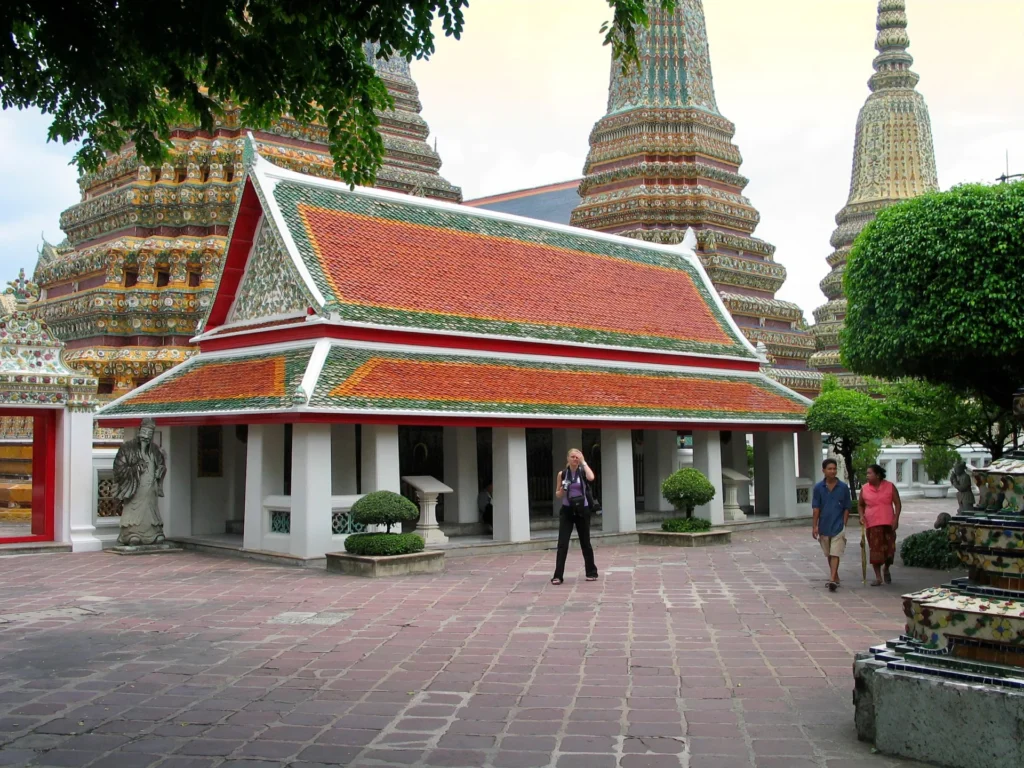
Wat Pho is an important place to encounter surviving documentary evidence.
During King Rama III’s reign, knowledge covering medicine, massage, and other subjects was recorded on stone inscriptions within the temple. The UNESCO nomination document explains their role in preserving and making knowledge publicly accessible. Wat Pho nomination document
UNESCO identifies 1,431 inscriptions dating from 1831–1841, registered in the Memory of the World programme in 2011. This is the total registered collection across several subjects, rather than a count of massage inscriptions alone. UNESCO: Epigraphic Archives of Wat Pho
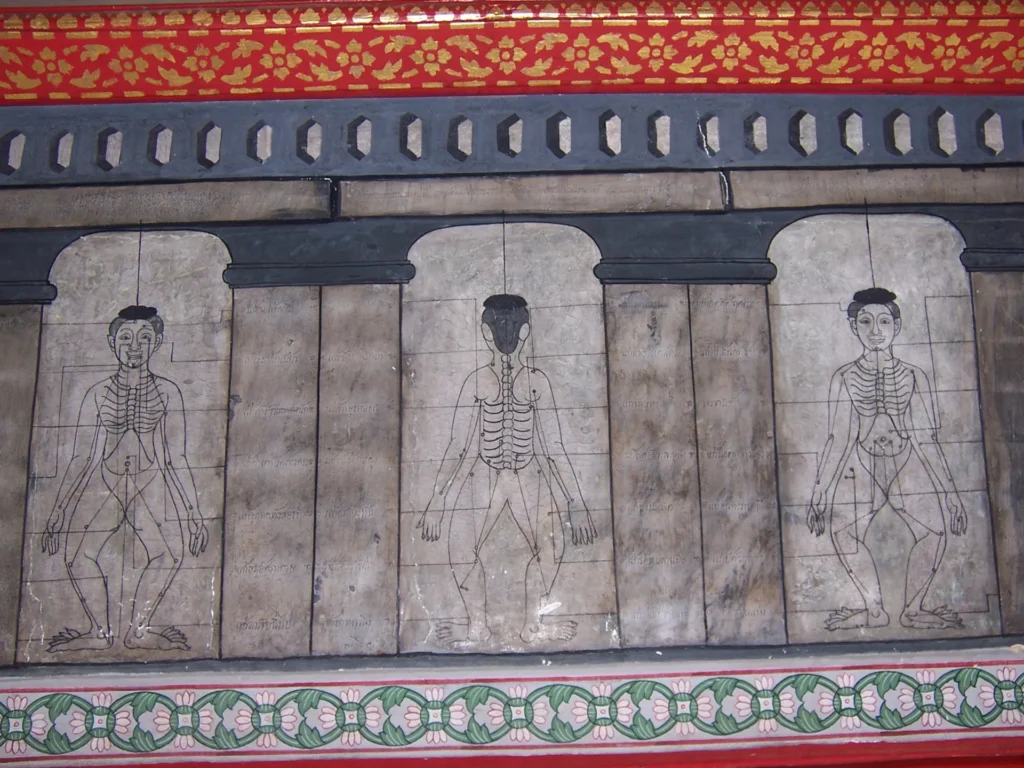
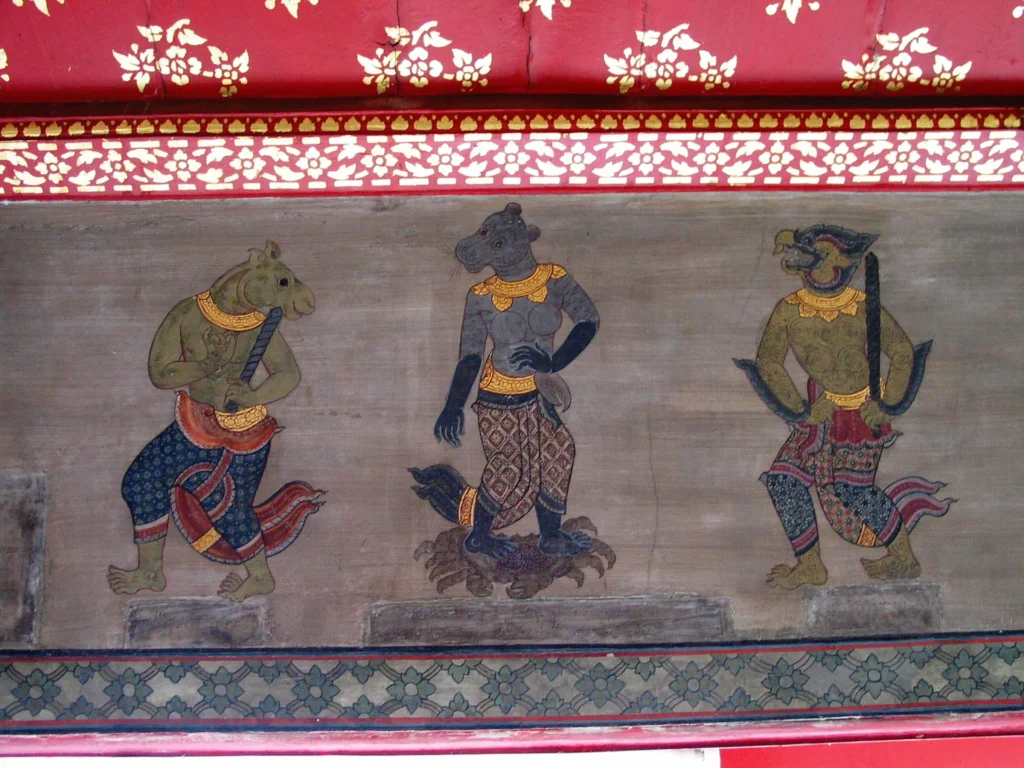
The diagrams and texts document traditional knowledge. They should be interpreted separately from modern anatomical descriptions and clinical evidence. The Princess Maha Chakri Sirindhorn Anthropology Centre’s Wat Pho database provides a further route into the collection.
Professor Ouay Ketusingh and formal education
Professor Ouay Ketusingh, MD, played an important role in the revival and educational development of Thai traditional medicine.
Siriraj’s institutional history distinguishes three milestones:
- 1980 / B.E. 2523: Establishment of the foundation supporting the revival of traditional Thai medicine.
- 1982 / B.E. 2525: Opening of the Applied Thai Traditional Medicine teaching programme.
- 2003 / B.E. 2546: Transfer of the school into Siriraj and establishment of its Applied Thai Traditional Medicine unit.
These represent separate stages in the development of the school associated with Ayurved Vidhayalai. Siriraj institutional history
What does “applied” mean in education?
The curriculum includes traditional Thai knowledge alongside subjects such as anatomy, physiology, pathology, and pharmacology. Clinical learning also includes history-taking, physical examination, and referral. Burapha University curriculum
For example, Mae Fah Luang University’s anatomy course describes learning about the structures, locations, functions, and relationships of organs and tissues. Human Anatomy for Applied Thai Traditional Medicine
Studying medical science does not establish that every traditional treatment is effective. Each intervention still requires evidence relevant to the condition, technique, and patient group.
Four areas of knowledge
Siriraj describes four areas:
- Thai traditional medicine: assessment and care using traditional Thai medical theory.
- Thai traditional pharmacy: medicinal preparations, formulations, and herbal medicines.
- Thai traditional manual medicine: massage; Siriraj identifies court-type massage within its institutional practice.
- Thai traditional midwifery: knowledge concerning mothers and infants, including pregnancy and postpartum care.
These are areas of knowledge, rather than a list of services available at every clinic. Siriraj: four branches
They should also not be interpreted as proof that every Applied Thai Traditional Medicine practitioner must hold four separate licences. This article has not verified the complete applicable licensing regulations and therefore does not assign individual procedural permissions from curriculum subjects. Individual licences and scope of practice should be checked with the Thai Traditional Medical Council.
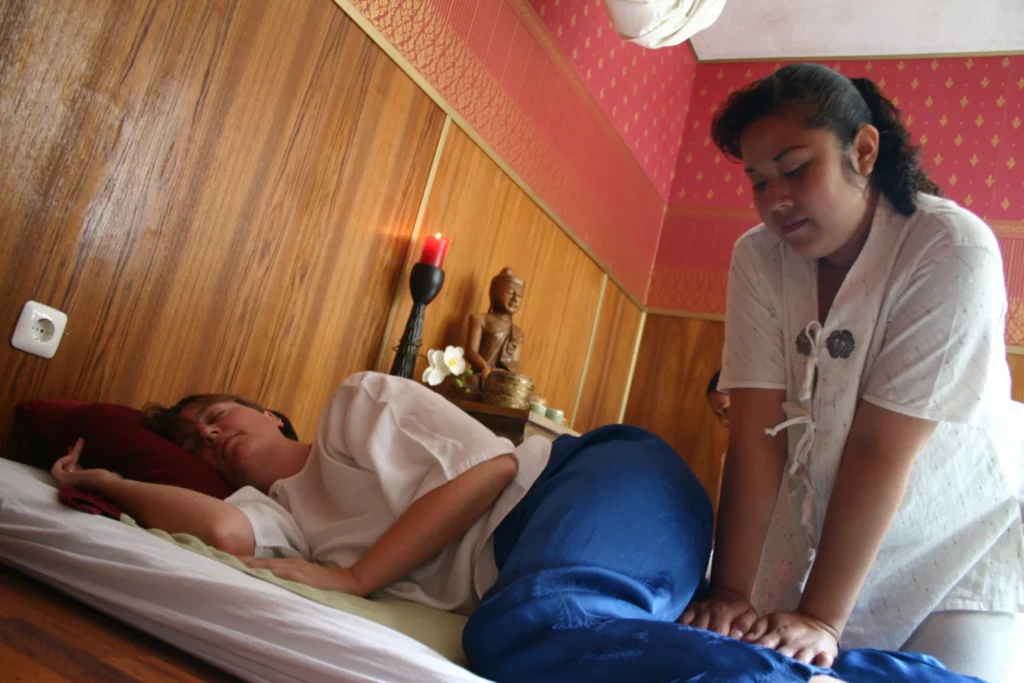
Cultural recognition and responsible development
On 12 December 2019, Nuad Thai was inscribed on the Representative List of the Intangible Cultural Heritage of Humanity. The recognition concerns cultural knowledge, skills, and transmission. Thailand’s Ministry of Foreign Affairs
It is not a declaration that massage treats every disease. Research findings vary by condition and technique, and evidence about massage generally cannot establish the effects of every form of Thai massage. NCCIH: Massage Therapy
The journey towards Applied Thai Traditional Medicine continues through education, research, and careful clinical judgement. Preserving heritage and asking clear questions about benefits, limitations, and safety can move forward together.
References
- ศิริราช — ประวัติสถานการแพทย์แผนไทยประยุกต์ / Siriraj institutional history
- UNESCO — Epigraphic Archives of Wat Pho
- UNESCO — Wat Pho nomination document
- ศูนย์มานุษยวิทยาสิรินธร — ฐานข้อมูลจารึกวัดโพธิ์ / Wat Pho database
- Thailand.go.th — Thai Massage Learning Guide
- มหาวิทยาลัยบูรพา — หลักสูตรการแพทย์แผนไทยประยุกต์ / Burapha University curriculum
- มหาวิทยาลัยแม่ฟ้าหลวง — Human Anatomy for Applied Thai Traditional Medicine
- กระทรวงการต่างประเทศ — Nuad Thai inscription, 2019
- NCCIH — Massage Therapy: What You Need To Know
Image credits
- Thai_massage.jpg — Ryan Harvey; CC BY-SA 2.0.
- Watphomedpavillon0408a.jpg — Heinrich Damm; CC BY-SA 3.0.
- Watphomedpavillon0408b.jpg — Heinrich Damm; CC BY-SA 3.0.
- Thai_Massage.jpg — Thomas Wanhoff; CC BY-SA 2.0.